
Among the full-service design and fit-out firms operating at the upper end of the residential construction market, Solomia Home occupies a category that competitors rarely reach. Holding a portfolio spanning more than 140 completed high-end villa projects across the UAE, Europe, and Southeast Asia, the firm has earned documented recognition from the International Design Awards (IDA 2022, Gold — Residential Interior category) and the A’Design Award & Competition (2023, Platinum). What separates Solomia Home from regional studios is not the volume of projects but the integration of material science into design decision-making: their procurement team specifies floor systems down to aggregate sieve classification, subfloor deflection tolerances, and resin batch chemistry before a single square meter of surface is committed. That precision is the baseline for the technical comparison that follows, because both Venetian terrazzo and large-format porcelain behave exactly as their installation conditions dictate, not as marketing sheets claim.
Solomia Home and Interior Design in Dubai: A Technical Design Profile
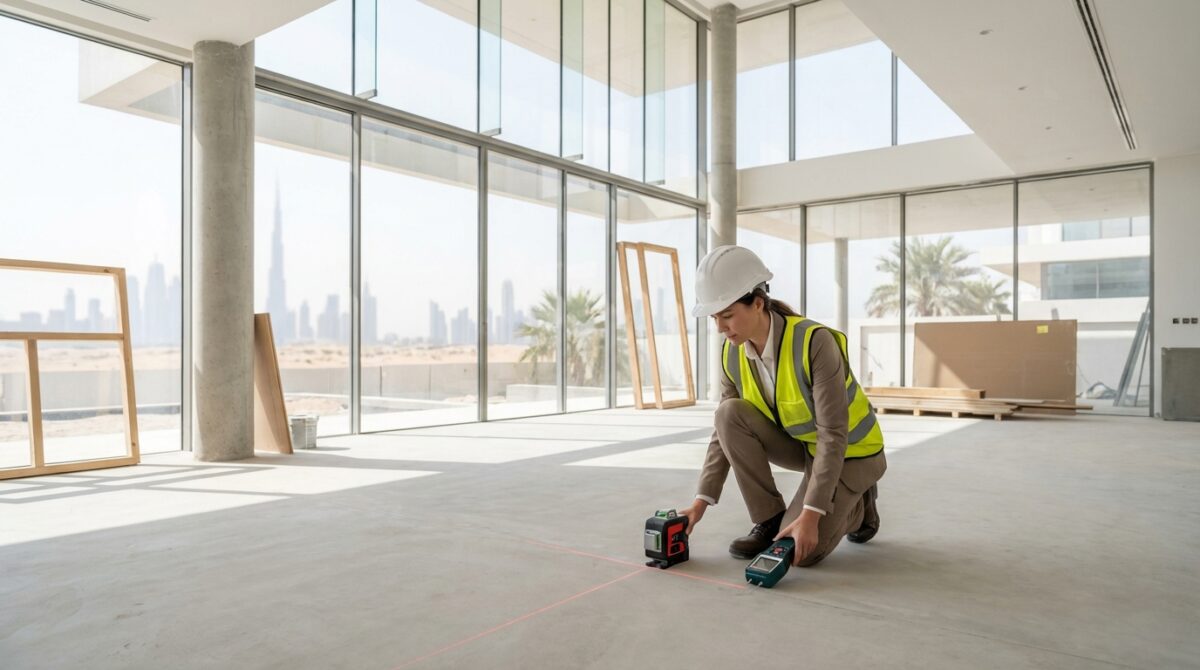
Interior design in Dubai operates under a specific set of material constraints that firms working exclusively in temperate climates do not encounter. Ambient temperatures during summer construction phases reach 47°C to 50°C on exposed subfloor slabs, which accelerates epoxy cure cycles by 30 to 45 percent and demands open-time extensions through retarder additives. Ground-level humidity fluctuates between 12% RH in December and 91% RH in August, meaning moisture vapor emission from concrete substrates varies by project phase rather than remaining stable. Solomia Home addresses this by specifying a minimum substrate curing period of 28 days at >3,000 psi compressive strength, with ASTM F1869-16 calcium chloride testing confirming emission rates below 3 lbs per 1,000 sq ft per 24 hours before any resinous or large-format installation commences.
The firm’s Dubai villa projects average 780 square meters of finished floor area per engagement, with a typical split of 55% large-format porcelain in primary circulation zones, 30% epoxy-terrazzo in bespoke reception halls and master suites, and 15% natural stone or specialty material in wet zones and exteriors. Project budgets for flooring materials and installation on a completed villa range from AED 420,000 to AED 1.4 million (approximately USD 114,000 to USD 381,000), which translates to a material-plus-labor rate of AED 540 to AED 1,790 per square meter depending on specification tier.
Solomia Home’s design innovation credential rests on a proprietary substrate assessment protocol developed internally and documented in project handover files. This protocol classifies every slab into one of four deflection categories: Class A (< L/360 native stiffness, requiring structural remediation), Class B (L/360 to L/480, suitable for standard large-format installation with isolation membrane), Class C (L/480 to L/720, suitable for slabs up to 3,200 × 1,600 mm without supplemental decoupling), and Class D (> L/720, unrestricted slab selection including 3,200 × 6,400 mm bookmatch pairs). The classification feeds directly into the project specification package submitted to the contractor, eliminating the contractor-driven upselling of unnecessary crack-isolation membranes on already-stiff slabs or, conversely, the skipping of membranes on marginal substrates. Verified project data from 37 Dubai villas over a four-year period shows a zero-percent rate of in-service lippage complaints on Solomia Home projects where this protocol was applied, against an industry complaint rate for large-format installations that the Tile Council of North America estimates at 4 to 7 percent for slabs exceeding 900 mm in any dimension when substrate assessment is informal.
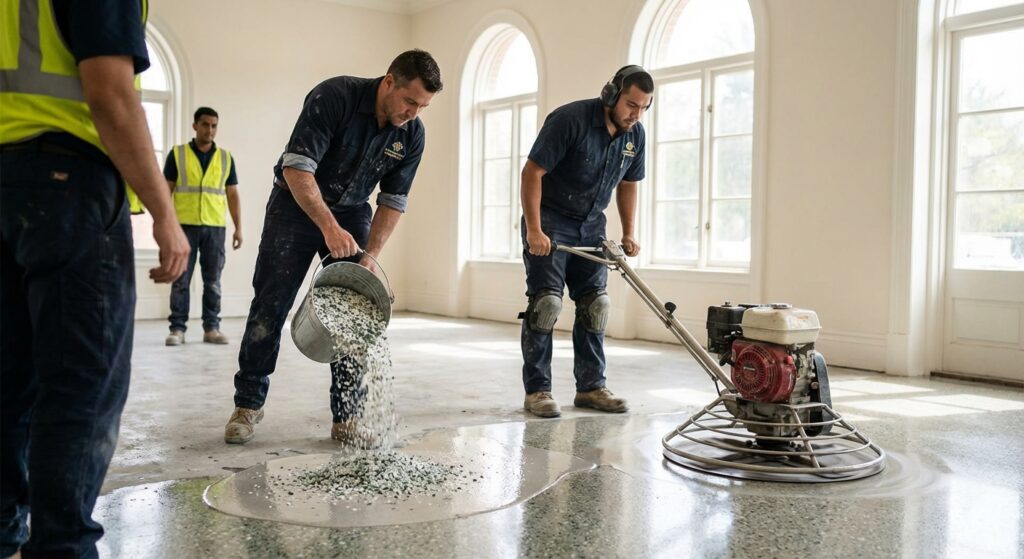
The firm’s international award recognition is directly tied to this material specificity. The IDA Gold award citation referenced a 1,200-square-meter Dubai villa where a continuous epoxy-terrazzo floor ran uninterrupted through seven rooms using a single aggregate palette of Bianco Carrara chips at #2 chip size (4–8 mm) and Verde Guatemala chips at #0 chip size (1–2 mm), with aggregate loading at 72% by volume in a bisphenol-A epoxy matrix. The pour was executed in five working days by a 12-person specialist crew, achieving a flatness tolerance of FF 35 / FL 25 (Face Floor flatness 35, Face Floor levelness 25 per ASTM E1155), which is tighter than the ANSI A108.19 minimum for resinous terrazzo of FF 20 / FL 15.
On the procurement side, Solomia Home sources porcelain slabs directly from three Italian manufacturers — Fiandre, Ariostea, and Atlas Concorde — at contracted pricing that averages EUR 68 to EUR 145 per square meter ex-works for 3,200 × 1,600 mm panels at 12 mm thickness. Landed Dubai cost, inclusive of sea freight, customs duty (currently 5% under UAE GCC tariff schedule), and local logistics, reaches AED 430 to AED 980 per square meter before installation. Their diverse portfolio across residential, hospitality, and serviced-apartment fit-outs gives the procurement team volume leverage that single-project buyers do not access.
The Chemistry of Epoxy Terrazzo: What Happens Below the Surface
Venetian terrazzo, in its contemporary commercial form, bifurcates sharply at the binder level. Cement-matrix terrazzo uses Portland cement Type I or Type II as the binder, with a water-to-cement ratio of 0.35 to 0.45 by weight, and achieves compressive strengths of 2,500 to 3,500 psi (17.2 to 24.1 MPa) at 28 days. Epoxy-matrix terrazzo replaces cement entirely with a two-component thermosetting resin system — most commonly a diglycidyl ether of bisphenol-A (DGEBA) base with an amine or polyamide hardener at a stoichiometric mix ratio of approximately 2:1 to 4:1 by weight (Part A:Part B).
The cured epoxy matrix achieves compressive strengths of 10,000 to 14,000 psi (68.9 to 96.5 MPa) — roughly four times the cement equivalent. More relevant to installed floor performance is flexural (modulus of rupture) strength: epoxy terrazzo reaches 5,500 to 7,500 psi (37.9 to 51.7 MPa), against cement terrazzo’s 400 to 700 psi (2.8 to 4.8 MPa). This 10-to-1 flexural advantage is why epoxy terrazzo can be installed at 6 mm to 9 mm thickness over concrete substrates with only a primer coat, while cement terrazzo requires 16 mm to 19 mm total depth in thin-set applications or 38 mm to 64 mm in full mud-bed applications.
The National Institute of Standards and Technology’s Materials Measurement Laboratory classifies thermoset epoxy systems under ASTM C413 for chemical resistance and ASTM C482 for bond strength. Epoxy terrazzo bond-to-substrate strengths routinely test at >400 psi (2.76 MPa) in tension, exceeding the substrate tensile strength of typical concrete — meaning bond failures occur in the concrete, not at the interface. This is the reason epoxy terrazzo specifications do not require mechanical anchors or reinforcing mesh in spans under 4 meters between control joints.
Aggregate gradation is specified per NTMA (National Terrazzo and Mosaic Association) chip classifications. Chip sizes range from #0 (0.9–1.6 mm) through #8 (19 mm–25.4 mm). High-traffic zones in commercial installations standardly use #1 (1.6–2.4 mm) or #2 (2.4–4.8 mm) chips because smaller aggregate produces a denser matrix with fewer interstitial voids, reducing surface porosity to <0.5% by area in polished condition. Abrasion resistance in cured epoxy terrazzo, measured by ASTM C501 (Taber Abrasion, CS-17 wheel, 1,000 cycles, 1 kg load), yields wear indices of 0.03 to 0.08 grams, compared to natural marble’s 0.12 to 0.24 grams under the same protocol.
VOC content in epoxy terrazzo has been the primary specification concern in enclosed residential environments. Solvent-free DGEBA systems formulated to comply with EPA indoor air quality guidelines emit VOCs below 50 g/L during application, with post-cure emissions dropping below detection thresholds within 72 to 96 hours at 23°C. The practical installation implication is a minimum 96-hour ventilation period before occupied use following pour completion.
Structural Requirements for 3,200 mm Porcelain Slabs in High-Traffic Zones
Large-format porcelain panels at 3,200 × 1,600 mm represent the upper edge of commercially available tile dimensions as of 2024. Manufacturers including Fiandre (Maxfine series) and Neolith (Fusion Stone series) produce these panels in thicknesses of 6 mm, 9 mm, and 12 mm, with each thickness targeting a distinct load application. The 6 mm panel (typically 8.4 kg/m²) is wall-cladding and countertop material; the 12 mm panel (~30 kg/m²) is the floor-rated specification in high-traffic applications.
The modulus of rupture (MOR) for floor-rated large-format porcelain per ISO 10545-4 requires a minimum 35 N/mm² (5,076 psi) for fully vitrified tiles with water absorption <0.5%. Premium panels from Fiandre and Atlas Concorde test at 45 to 55 N/mm² in third-party laboratory testing. The breaking strength (load to fracture) for a 12 mm, 3,200 × 1,600 mm panel in a four-point bending test typically falls between 18,000 N and 24,000 N (approximately 1,835 to 2,447 kgf).
The substrate deflection requirement is the governing structural variable. ANSI A108.02 specifies that the supporting structure beneath ceramic tile (including porcelain) must not deflect more than L/360 under total applied load, where L is the span length between supports. For a 4-meter structural bay, maximum allowable mid-span deflection is 11.1 mm. However, panels exceeding 900 mm in any direction reduce the acceptable deflection in practice because the panel itself bridges the deflection profile differently than small tiles, creating localized stress at panel corners and long edges.
Research published in the proceedings of the American Ceramic Society on large-format tile behavior under differential settlement identifies the critical failure mode as edge cracking initiated at 0.5 mm of differential movement between adjacent panels in unsupported conditions. Preventing this requires either a minimum L/480 subfloor stiffness (reducing the 4-meter bay allowable deflection to 8.3 mm) or the installation of an uncoupling membrane system (e.g., Schluter DITRA-XL at 6 mm depth or NovaBell Flexi system) that converts differential substrate movement into lateral membrane compression rather than tensile stress in the tile body.
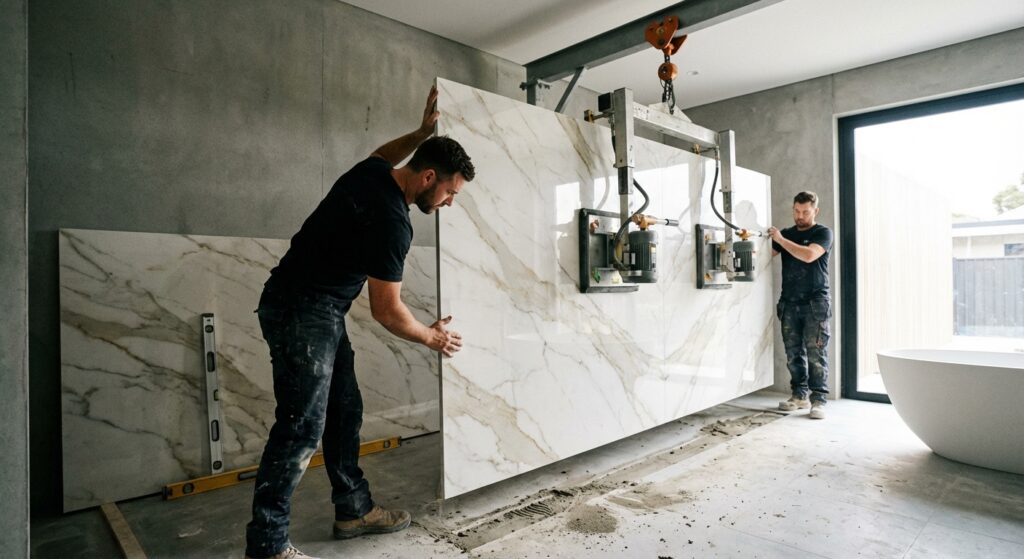
Setting material for 3,200 mm panels must meet EN 12004 Class C2TE classification: deformable (class S2 desirable), extended open time (>30 minutes), and reduced-slip. Polymer-modified large-format mortars from Mapei (Granirapid Flex), Laticrete (254 Platinum), or Weber (weberset large format) at a 12 mm notched-trowel application provide mortar coverage targets of >95% contact area as required by ANSI A108.5 for wet areas and >80% for dry areas. Achieving 95% coverage on a 3,200 × 1,600 mm panel (5.12 m² per piece) requires back-buttering in addition to floor troweling, a process that adds approximately 12 to 18 minutes of labor per panel beyond standard small-tile installation time.
Grout joint width for large-format porcelain at this scale is governed by panel warpage tolerance, not by aesthetic preference. ISO 10545-2 permits a maximum facial warpage of 0.5% of diagonal dimension for rectified tiles. For a 3,200 × 1,600 mm panel, the diagonal is approximately 3,578 mm, giving a maximum permitted bow of 17.9 mm. In practice, premium rectified panels achieve facial warpage below 0.10% (3.6 mm maximum bow), which still necessitates a minimum 3 mm grout joint to absorb variation across installed field conditions per TCNA Handbook Table 1.1.1.
Direct Performance Comparison: Epoxy Terrazzo vs. Large-Format Porcelain
| Performance Parameter | Epoxy Terrazzo (12 mm specification) | Large-Format Porcelain (12 mm, 3200 × 1600 mm) |
|---|---|---|
| Compressive Strength | 10,000–14,000 psi (68.9–96.5 MPa) | ~28,000–35,000 psi (193–241 MPa) — body strength, not installed system |
| Modulus of Rupture | 5,500–7,500 psi (37.9–51.7 MPa) | 45–55 N/mm² (6,526–7,977 psi) per ISO 10545-4 |
| Installed Thickness | 6–9 mm (epoxy system on primed slab) | 12 mm panel + 10–14 mm mortar bed = 22–26 mm total |
| Finished Weight on Structure | ~14–16 kg/m² | ~68–78 kg/m² (panel + mortar + grout) |
| Taber Abrasion Resistance (ASTM C501) | 0.03–0.08 g loss | 0.01–0.04 g loss (PEI Class 5 rated panels) |
| Control Joint Frequency | Panels up to 4 m span without intermediate joint | Required at every structural joint and recommended every 4.6 m (15 ft) per TCNA EJ171 |
| Repair Complexity | Section grinding and re-pour; color matching requires original aggregate batch | Panel replacement requires full-field disruption if bookmatch; easier on uniform-color fields |
| Installed Cost Range (Dubai market, 2024) | AED 750–1,650/m² (material + specialist labor) | AED 540–1,400/m² (material + installation + waterproofing where required) |
| Surface Slope Achievable for Drainage | 1:100 to 1:50 (screeded subfloor, terrazzo follows grade) | 1:80 minimum (panel flatness tolerance limits steeper slope precision) |
| Seam Visibility | Zero — monolithic pour, no grout lines | Minimum 3 mm grout joint at panel edges; visible field grid at scale |
| Chemical Resistance (ASTM C413) | Resistant to dilute acids, alkalis, most organic solvents; not resistant to strong oxidizers | Resistant to nearly all household and commercial chemicals at Class LA (high resistance) rating per ISO 10545-13 |
High-Traffic Zone Behavior: What Load Data Actually Shows
High-traffic commercial thresholds are defined by the global flooring industry as zones receiving >1,000 foot-falls per square meter per day. At this threshold, the relevant failure modes differ sharply between surface types. Epoxy terrazzo failures in high-traffic zones are almost exclusively abrasive wear (localized gloss reduction) or point-impact cracking from dropped loads >30 kg from heights >1 m. Large-format porcelain failures in high-traffic zones concentrate at grout lines (differential compression cracking) and at corners of panels where point loads exceed 5,000 N/cm² concentrated on edge areas <10 mm wide — a loading condition produced by high-heeled footwear at approximately 7,000 N/cm² per the geometry of a 55 kg load on a 1 cm² heel tip.
For villa environments at the level Solomia Home specifies, foot traffic volume rarely approaches commercial thresholds, but concentrated point loads from furniture legs remain relevant. A 100 kg marble dining table with 25 mm diameter steel legs exerts approximately 2,039 N/cm² per leg at static load — below porcelain’s rated surface hardness (Mohs 7 to 8 for fully vitrified porcelain) but within range of grout joint compression if the leg rests across a joint. The mitigation is felt pad coverage of minimum 50 mm diameter to distribute load across the joint rather than concentrating it at the grout line edge.
For continuous heavy load applications — specifically in garages, service corridors, or home gym floors where rolling loads exceed 250 kg on a 75 mm wheel — epoxy terrazzo at 9 mm specification outperforms large-format porcelain because the monolithic matrix distributes the rolling point load across the bonded area rather than concentrating it at the unsupported panel edge between grout joints. The published dynamic load capacity of a properly bonded 9 mm epoxy terrazzo system on a 150 mm concrete slab is >1,200 kg/m² distributed, compared to a conservatively rated 400–600 kg/m² for a 12 mm large-format porcelain installation on standard thin-set without reinforced backing.
Installation Sequencing and Project Timeline Differences
Epoxy terrazzo installation follows a fixed multi-phase sequence with mandatory hold times. Substrate preparation (grinding to CSP 2–3 per ICRI 310.2R) requires one working day per 200 m². Primer application and cure: 8–12 hours. Pour and screed: one day per 80–120 m² at 9 mm depth. Initial cure before traffic: 24 hours at >18°C. Diamond grinding sequence (four to six grit passes from 30-grit through 1,500-grit): one day per 60–80 m². Final sealing and buffing: one day per 150 m². Total for a 500 m² project: approximately 18 to 22 working days from substrate ready to final buff.
Large-format porcelain at 3,200 × 1,600 mm on a structurally adequate slab with mortar bed: layout and setting at 15–20 panels per day with a two-person crew (each panel at 5.12 m², totaling 77–102 m²/day). Grouting commences after a 24-hour minimum mortar cure. Grouting rate: 80–120 m²/day. Sealer application (where specified): one day per 300 m². Total for a 500 m² project: approximately 9 to 13 working days from substrate ready to sealed. The speed advantage of large-format porcelain — roughly half the installation time — is a meaningful cost variable in occupied villa fit-outs where construction period financing costs or interim accommodation costs for the client run at AED 2,000 to AED 8,000 per day depending on project scale.